
Your Product’s Early Adopters Might Not Be Who You Think They Are – Lessons from VeggieTales
When my sons were pre-schoolers, VeggieTales® — particularly the Silly Songs like “The Hairbrush Song,” “Song of the Cebu,” and “The Pirates Who Don’t Do Anything” — were an integral part of our lives.


With his trademark wit and a healthy dose of silliness, Phil reflects on the rise and fall of Big Idea Productions, the original parent company behind the VeggieTales empire.
Phil’s explanation of how people became “infected” with the VeggieTales “epidemic” intrigued me.
Who do you think were the original “brand evangelists” for VeggieTales?
I guessed moms of young children.
I was wrong.
Phil says, “Young moms were too busy taking care of their kids and driving to soccer practice to try every new video that showed up in a Christian bookstore… this vegetable thing? They thought. Who has time to give it a try? It’s probably stupid and cheap…”
The audience that did get VeggieTales going was college kids and young, single adults. More specifically, college kids and young, single adults who worked in Christian bookstores. Phil writes:
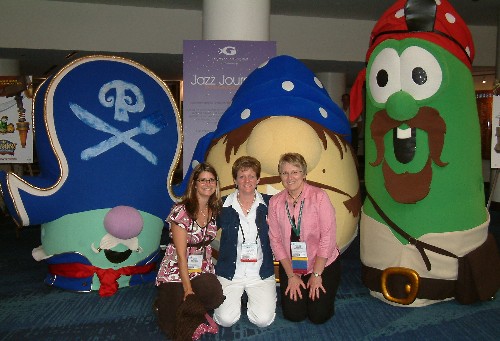
Jenn Doucette, Laura Christianson and Grace Fox at a preview screening of "The Pirates Who Don't Do Anything," Atlanta, 2007.
“In the early 1990s, most Christian bookstores were small independents that often filled out their staffs with college kids and young singles working part-time. Particularly in less vital areas of the store, like, say, children’s products. By 1994, with home video boom in full swing, just about every Christian bookstore had a TV and a VCR in the back, most often in the kids’ department where some Christian kids’ video invariably looped all day long, making the young staff member assigned to that area a little, well, loopy. When VeggieTales came along, it was at least worth a look. So these college kids and young adults would open a VeggieTales video and pop it in just to check it out.
And they loved it. The Monty Python references, the severe tongue-in-cheekiness, “The Hairbrush Song.” It was exactly what college kids and young single adults had never seen before in a Christian kids’ video: something they would actually enjoy watching.”
VeggieTales parties began springing up at colleges and universities around the country.
And the college students who worked in Christian bookstores began playing all VeggieTales all the time.
When harried mothers walked in looking for new videos, the young clerks responded, “Have you heard of VeggieTales?”
“No—what’s that?”
“Look! It’s playing right here! In fact, your kids are watching it right now! And they’re smiling!”
Ring it up, Bucky.
Had Phil and company launched VeggieTales first at Walmart, Target, or Toys “R” Us, the “college student as early adopter/promoter” would never have happened. That’s because, in mass market stores, the store clerks can’t touch the VCRs (airtime in the big box stores is reserved for vendors who fork out the big bucks for the privilege—kind of like naming rights for football stadiums).
Phil says, “Had the clerks in local Christian bookstores not have been able to play the videos they liked, moms may never have bumped into VeggieTales. Big Idea Productions may have gone out of business before anyone knew we even existed. As it happened, exposure through Christian bookstores was the fuse that college kids had just lit. Bob and Larry were ready to explode.”
Who Are Your Brand Evangelists?
I hope this story inspires you to reconsider who your “brand evangelists” are.
I hear from lots of people who tell me, “My blog’s dead in the water.” Or, “My business is stagnant.”
If that’s the case, perhaps, like Phil, you’re preaching to the wrong choir. Or you haven’t yet discovered that ideal audience who will become hard-core fans of your brand and tell everyone they know about you.
If you’re feeling brave, try this exercise:
In the Comments area, share one primary product, service, or idea that you “sell” (whether you collect money for “selling” or do it for the joy of sharing). Don’t tell us who your ideal audience is – just tell us what you promote.
Those of us who read your comments will suggest audiences we think could become early adopters and promoters of your “for sale” item.
Who knows…someone might suggest an audience you haven’t yet tapped – an audience who just might explode your “Bob” or “Larry.”
I’d like to find the audience for a picture book, Signs of Trouble, about kids who get separated from their Special Ed class on a field trip to a mall and use what they’ve learned about safety rules and reading signs to get back with the class. The book includes some learning activities to help kids understand special needs and to recognize signs and learn safety rules themselves.
I’d like to find the audience for a picture book, Signs of Trouble, about kids who get separated from their Special Ed class on a field trip to a mall and use what they’ve learned about safety rules and reading signs to get back with the class. The book includes some learning activities to help kids understand special needs and to recognize signs and learn safety rules themselves.
My initial reaction for your audience, Janet, would be elementary school teachers, librarians, and curriculum directors at public schools. You could also target local elementary schools that cater to special needs students. For instance, in our school district, all of the elementary students who have autism attend one school, and another school has a program for kids who are deaf, etc.
My initial reaction for your audience, Janet, would be elementary school teachers, librarians, and curriculum directors at public schools. You could also target local elementary schools that cater to special needs students. For instance, in our school district, all of the elementary students who have autism attend one school, and another school has a program for kids who are deaf, etc.
I had to laugh when I read it was college students who first discovered VeggieTales. I was a college student and a mother of young kids, when my grown, Jewish, Bible-lit professor had us watch VeggieTales during class. That was my introduction.